Buying a Mattress: Trial Periods, Fees and What to Compare
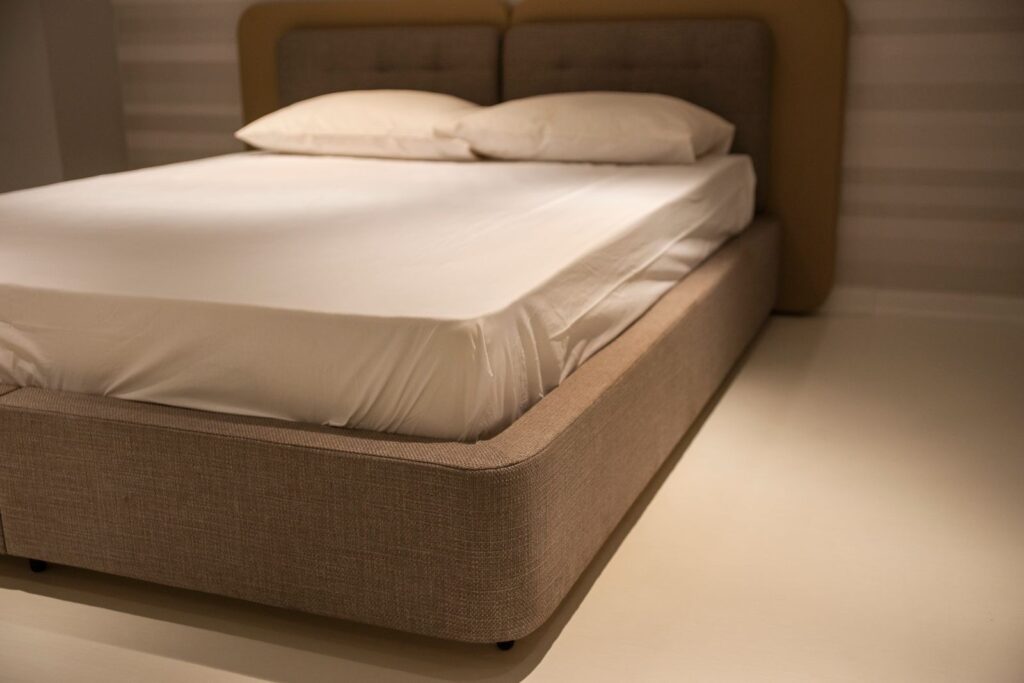
A mattress is a once-a-decade purchase that most people research less than a toaster. Short version: typical sleep trials run 90 to 120 nights, but the return terms matter more than the number. A mandatory break-in, a return fee and a condition rule can turn “risk free” into a $99 lesson. Compare construction, not model names, read the warranty for sag depth and foundation rules, and buy a protector on day one.
Key takeaways
- A sleep trial is only as good as its fine print: break-in minimums, return fees, who arranges pickup, and whether the mattress must be clean and undamaged.
- Sag depth in a warranty is usually 1 to 2 inches, and the foundation you use can void the whole thing.
- The same mattress is often sold under different names at different stores, so compare layers and thicknesses, not marketing names.
- Federal rules cover fire resistance and labels; check the label before you pay.
- Plan the exit: old-mattress removal, return logistics and, in four states, recycling.
Sleep trials: the number is not the point
According to the Sleep Foundation, the average trial lasts about 90 to 120 nights. Some run 30 nights, and a few go a year or longer. The same page notes that adjusting to a new bed can take about a month, so a 30-night trial is barely a trial. Think of it as the window in which you are allowed to change your mind, and then read what it costs to use it.
Break-in periods
Many companies require you to sleep on the mattress for a minimum period before they will take it back, typically two weeks to a month, according to the Sleep Foundation. Write down the date you could first request a return.
Fees, shipping and pickup
Refunds are not always full. You may owe shipping, handling or restocking fees, and extras such as expedited shipping, delivery to Alaska or Hawaii, and old-mattress removal are usually not refunded. Some brands want it shipped back, others schedule a pickup, and some accept proof of donation or recycling instead. Ask before you buy who arranges it, who pays, and whether you must prove a donation.
Where you buy changes the deal
Trials often apply only to purchases made directly from the brand. Tempur-Pedic’s return policy page, for example, says products bought in a retail store follow that retailer’s return and exchange rules. The Sleep Foundation similarly warns that third-party sellers such as Amazon may differ from the manufacturer. If the trial is why you picked the bed, buy where it applies.
Real policies, as examples (November 2026)
Policies change, so treat these as illustrations of what to look for, not recommendations. Both were read from the companies’ own pages in November 2026.
- Saatva describes a 365-night trial for mattresses, a $99 processing fee that is deducted from a refund or paid upfront for an exchange, and a scheduled pickup. It says returned bedding items are donated to local charities. The page carries a date of November 18, 2025, so confirm it is still current.
- Tempur-Pedic describes a 90-night trial with a requirement to sleep on the mattress at least 30 nights before calling, and says the refund is reduced by a return shipping fee. The page does not state the amount. Closeout mattresses and foundations cannot be returned and are covered by warranty instead.
The pattern: a long trial with a flat fee, versus a shorter trial with a minimum and an unstated fee. Know your number before you lie down.
| Term to check | Why it matters | What the examples show (Nov 2026) |
|---|---|---|
| Trial length | Defines your exit window | 365 nights (Saatva); 90 nights (Tempur-Pedic) |
| Break-in minimum | You cannot return early | 30 nights stated by Tempur-Pedic; not specified by Saatva’s page |
| Return fee | Cost of changing your mind | $99 (Saatva); a shipping fee of an unstated amount (Tempur-Pedic) |
| Pickup or shipping | Whether you wrestle it yourself | Scheduled pickup (Saatva); not described (Tempur-Pedic) |
| Donation rule | Where the returned bed goes | Donated to charities (Saatva); not mentioned (Tempur-Pedic) |
| Retail-store purchase | May void the brand’s trial | Follows the retailer’s policy (Tempur-Pedic) |
Warranty terms that actually matter
The Sleep Foundation advises avoiding warranties shorter than 10 years, and notes they typically cover defects such as broken coils, cracked foam and premature sagging, not misuse. The headline number tells you less than four details inside.
Sag depth
Coverage usually starts only when the indentation reaches a stated depth. Brentwood Home’s warranty page uses a visible indentation of 1.5 inches or more, and excludes sagging caused by an unsuitable foundation. Other brands set different depths, so find the number and compare it. A deeper threshold is a smaller promise.
Proration
A 25-year warranty rarely means 25 years of free replacement. On the same Brentwood page, years 1 to 10 are full coverage (the buyer pays shipping), then the buyer pays 50 percent of the original price in year 11, rising 5 points a year through year 20, and 95 percent from year 21 onward. Generous early, symbolic late.
Foundation requirements
Warranties often specify what the mattress sits on. Brentwood’s page asks for 5 to 6 legs on queen and king frames, no more than 5 inches between slats, and slats at least 2.5 inches wide, and says an inappropriate foundation voids the warranty. Check your bed frame before you buy, not after the sag shows up.
Stains and the law tag
The same page says stains or an unsanitary mattress void the warranty, and that the tag must stay attached and unaltered. Leave it alone.
Comparing firmness, materials and price
The Sleep Foundation’s shopping guide rates firmness on a 1 to 10 scale, where most mattresses land between 5 and 6. It suggests roughly 4 to 6 for side sleepers, 6 to 7 for back sleepers and 7 to 8 for stomach sleepers, with lighter sleepers (under 130 pounds) tending toward softer beds and heavier ones (over 230 pounds) toward firmer, more supportive builds. Use those as a starting range, and test in person if you can.
The same guide gives a rough price map. The figures are the guide’s, and prices drift.
| Type | Typical traits (per Sleep Foundation) | Price range cited |
|---|---|---|
| Innerspring | Bouncy, strong edges, breathes well, weak pressure relief | About $250 to $1,000 for standard innerspring or foam |
| Foam | Quiet, good motion isolation, can sleep warm | Standard foam in the same range; better-quality foam or hybrid about $1,000 to $1,500 |
| Hybrid | Coils plus foam or latex, balanced feel | Higher because of the complex build |
| Latex | Durable, bouncy, naturally breathable | Natural latex or high-end hybrid often over $2,000 |
Across the market, the guide puts mattresses at about $300 to $4,000 or more. It adds that shipping, delivery or setup fees and payment plans can move the final total.
Comparing across brands without losing your mind
Model-name differences
GoodBed, an independent mattress guide, reports that retailers often sell the same mattress under different names so you cannot compare prices easily. It distinguishes “name game” models, which differ by store in both name and price, from minimum-advertised-price models, which share a name and price everywhere. In its own test of 19 stores, none identified the closest equivalent to a Sealy Posturepedic model. Ask for the layers instead: material, thickness, order.
Price anchoring and “sale” cycles
GoodBed also says name-game prices move often, sometimes by as much as $1,000, across stores and over time. That is why a “50 percent off” tag tells you little. The FTC’s guide on former-price comparisons says a former price should be the actual price at which the item was offered to the public regularly for a reasonably substantial period, not an inflated number invented to make a discount look big. You cannot audit a retailer’s history, but you can track the price yourself for a few weeks and compare totals including delivery and removal.
Flammability, labels and used mattresses
The Consumer Product Safety Commission enforces two federal mattress standards. For mattress sets, the open-flame rule caps peak heat release at 200 kilowatts and total heat release at 15 megajoules in the first 10 minutes of a 30-minute test. A separate cigarette standard limits char length to 2 inches. Mattresses must carry a permanent label with the month and year of manufacture and the manufacturing location, and sets carry a label with manufacturer, model and a compliance certification. The CPSC page, aimed at manufacturers, does not address whether owners may remove labels.
For used mattresses, the FTC’s long-standing advice is to look for a tag stating whether the mattress is new or used, and to shop elsewhere if it has none. If you find an unsafe product, the CPSC points consumers to saferproducts.gov.
Getting rid of the old one
Removal of your old mattress is usually an extra, and the Sleep Foundation lists it as typically non-refundable. Ask whether the seller hauls it away and what that costs. The Mattress Recycling Council runs programs in California, Connecticut, Oregon and Rhode Island, and says its program is not active elsewhere, where it suggests contacting your city or waste hauler. Fee amounts were not verified, so ask the seller whether a state fee applies.
Pre-purchase checklist
- Write down trial length, break-in minimum, return fee, and who arranges and pays for pickup.
- Confirm the trial applies to the exact place you are buying (brand site, store or marketplace).
- Get the layer list with materials and thicknesses, and compare it with the other store’s version.
- Find the sag depth, proration schedule and foundation rules in the written warranty.
- Check that your bed frame meets the foundation rules.
- Price the total: shipping, delivery, setup, removal, protector, any recycling fee.
- Buy a mattress protector before the first night and keep the tag attached.
- Screenshot the policy page on purchase day and set a calendar reminder for the trial’s end.
Frequently asked questions
How long is a typical sleep trial?
The Sleep Foundation puts the average at about 90 to 120 nights, with some at 30 nights and some a year or more. Many require a minimum break-in first, typically two weeks to a month.
Can I return a mattress for a full refund?
Sometimes, but not always. You may owe shipping, handling or restocking fees, and extras such as expedited shipping and old-mattress removal are usually not refunded. One example in November 2026 deducts a $99 fee from the refund.
Does a stain really void a warranty or a trial?
It can. Brentwood Home’s warranty page says stains void its warranty, and the Sleep Foundation says most companies void a trial if the mattress is soiled. A protector is the cheap insurance.
Is it safe to buy a used mattress?
The FTC’s advice is to look for a tag saying whether it is new or used, and to shop elsewhere if there is none.
Before you decide
Do the boring comparison first. Pick your firmness range, shortlist two or three mattresses by construction rather than name, then compare the return terms and warranty line by line. The mattress you will keep is the one whose exit costs you can live with. No brands are ranked here; the policy examples only show what to look for.
Sources
- Mattress Trial Periods – Sleep Foundation
- Mattress Shopping – Sleep Foundation
- Mattresses, Mattress Pads, & Mattress Sets – U.S. Consumer Product Safety Commission
- Consumers Can ‘Rest Easy’ Following FTC Settlements with Two Used Mattress Resellers – Federal Trade Commission
- 16 CFR § 233.1 – Former price comparisons – Legal Information Institute, Cornell Law School
- Saatva Return Policy: Mattresses, Pillows, & More – Saatva
- Return Policy – Tempur-Pedic
- What is the Brentwood Home warranty on Mattresses? – Brentwood Home Help Center
- How to Beat the Mattress Name Game – GoodBed
- Mattress Recycling Council (MRC) | There’s More to Every Mattress – Mattress Recycling Council
- Ready to get rid of your mattress? – Bye Bye Mattress, a program of the Mattress Recycling Council
Last updated: November 2026. This article is general information, not consumer or legal advice.